“When my nine-year-old daughter asked me who she was, American or Japanese? I told her that you can decide who you are.”
Sachiko Komagata is a college professor and physical therapist.
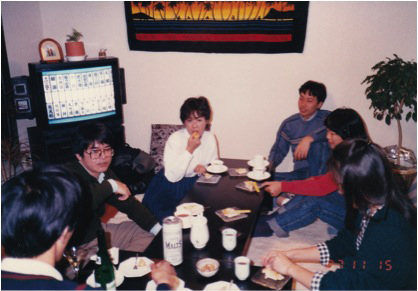
The last supper that Sachiko shared with her husband’s best friends from junior high school.
My husband got a job in New York City and we decided to come to the US for the very first time in our life with one-way airplane ticket. We cleared our apartment in Tokyo and took upon this adventure. People in Tokyo asked us why we were moving to the US when the Japanese economy was excellent, its cities are safe, clean. We had no fear but with the excitement of starting something from a scratch (no friends, no family, no acquaintances in the US). My brother-in-law reassured us that he would take good care of my father. It was reassuring and we felt gratitude towards all family members who were open-minded as we were.
We had a total of six cardboard boxes of our belongings to start our lives in the US. Jersey City, New Jersey, was our first residence. Beautiful brownstone apartments and houses were filled with diverse artists, professionals, and families of diverse origins, which felt like our new home. The apartment owner who lived upstairs was kind and supportive suggesting us to get an air conditioner while I was totally okay with 100-degree room temperature from the humid hot summers in Tokyo. There was a couple who lived above our apartment who fought each other many nights with violent sounds. I wondered if I should call the police many times but assumed that this may be the reality of some of the US household and did not intervene.
It is funny to think about, but I have now lived in the US longer than the time I lived in Tokyo. When I first arrived, I noticed so many differences between the two cultures. Even how heavy the doors are compared to the ones in Tokyo. Then I started to notice more similarities than differences in human experiences, sickness, death, poverty. Now switching back and forth between two cultures feels so effortless. Bilingualism goes beyond the language and extends into cultural appreciation, immersion, and interpretation. When my nine-year-old daughter asked me who she was, American or Japanese? I told her that you can decide who you are.
I am an amateur Japanese calligrapher. If I had stayed in Japan, I would not have picked up my brush. I think moving to the US, and thinking of my mother who was a calligraphy master, brought me back to pick up the brush. Japanese calligraphy for me is the connection to my mother who is not on this earth any longer. It is an art as well as a spiritual experience to sit down, pick up a brush, put it into black sumi ink and gaze at a blank sheet of paper and then through movement of the brush, something that was not there is forming . . . no regret, no bringing the time back to the past, just be where I am.
There at least three dinners that I recall now just before leaving Tokyo. One was at my husband’s close friend’s home from his junior high school. There were about ten friends gathered and we ate a simple pot-luck format dinner—all homemade. I personally do not recall but my husband tells me that we received money as a gift. We shared hearty laughter.
Another one was with my close friends from my junior high school at an Italian restaurant in Tokyo. I do not recall exactly what I ate, but I recall exactly where I sat in relationship to my friends. Our conversations were focused on reminiscing about our days as young adolescent girls and I recall that one of my friends shared her stereotype about the US (high crime rate and people have guns) and she was very concerned that I was moving to such a dangerous society. Another friend told me that the healthcare cost in the US is so expensive so she wished me well. I recall my attitude being “this is another trip so I would enjoy observing and learning from it.”
The true last supper before leaving Tokyo was at a Japanese restaurant at Narita Airport with my family. I recall that there were my widowed father, my older brother (now deceased), my older sister and her husband (now deceased). Since my husband left for New York six weeks prior to find an apartment, it actually was my very first trip alone anywhere. My father was always open-minded, supportive of my decisions—including my trip to Western Europe, when I got married at the age of nineteen, for my honeymoon. For that one-month trip, he gave me a dozen of photo film rolls and asked me to just take some pictures of Europe so we can enjoy seeing them after returning. He himself wanted to visit the US when he was younger as I heard directly from him when I was younger. His own father, my grandfather, tried to immigrate into Indonesia and operate a coffee plantation but the business failed and he came back. Although we did not travel much when I was growing up, he encouraged us, his children, to travel far when we are still young adults and our sensibility robust. Another older sister of mine immigrated to Australia just before our move to the US. Something in my blood made me move like salmons and go up the stream. When my mother passed away, she asked me to be gentle and kind to my father. My brother-in-law’s kind reassuring words “we will take good care of your father” put me at ease as I departed Tokyo leaving my family not knowing how ever long this trip may become.

The last supper with Sachiko shared with close friends before departing for the US.
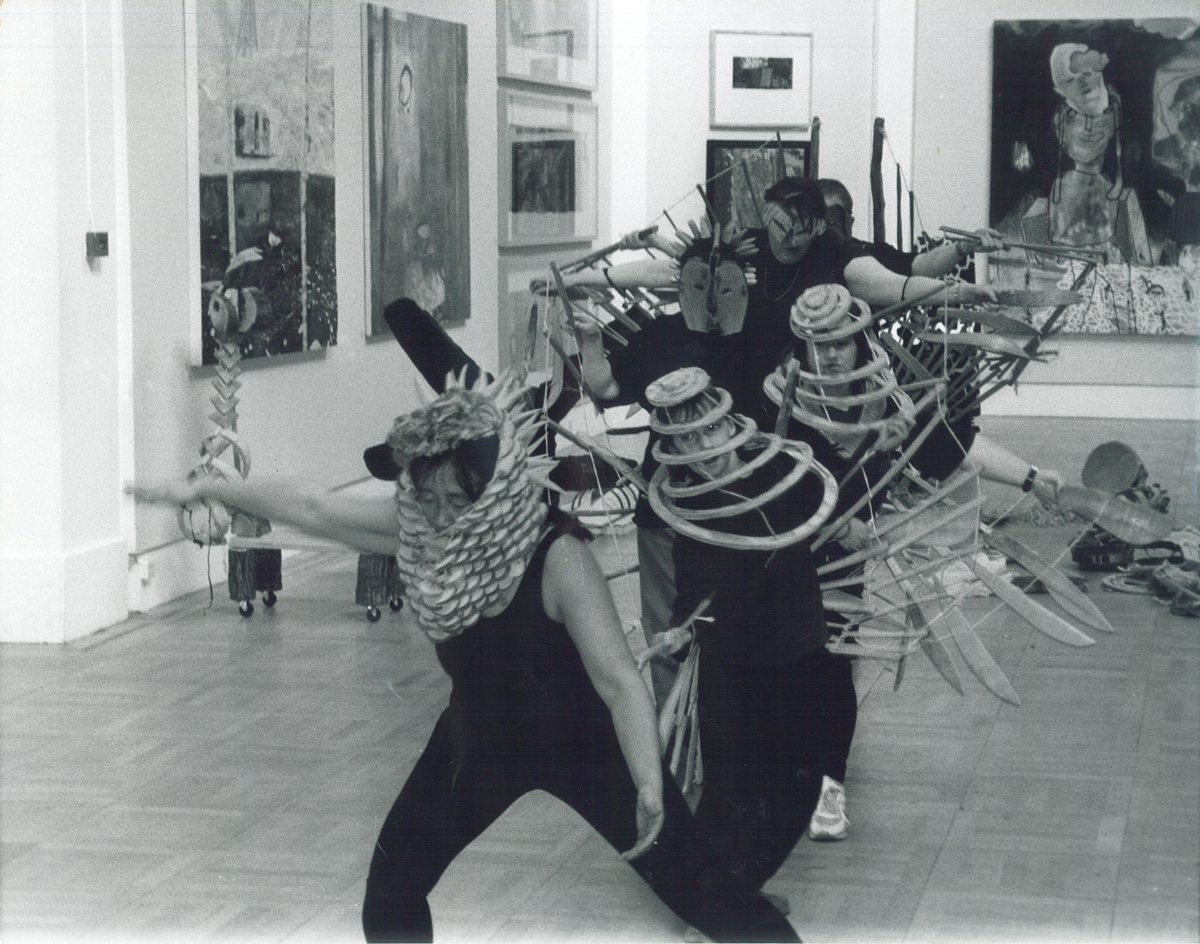
Portraits of People on the Move tells the stories of Philadelphia-area immigrants through their own words on the Supperdance.com blog and was first shown as an exhibition June 25–28, 2015, at the Gray Area of Crane Arts in Philadelphia. The exhibition was created as a companion work to Supper, People on the Move by Cardell Dance Theater, a dance inspired by themes of migration.

 supperpeopleonthemove