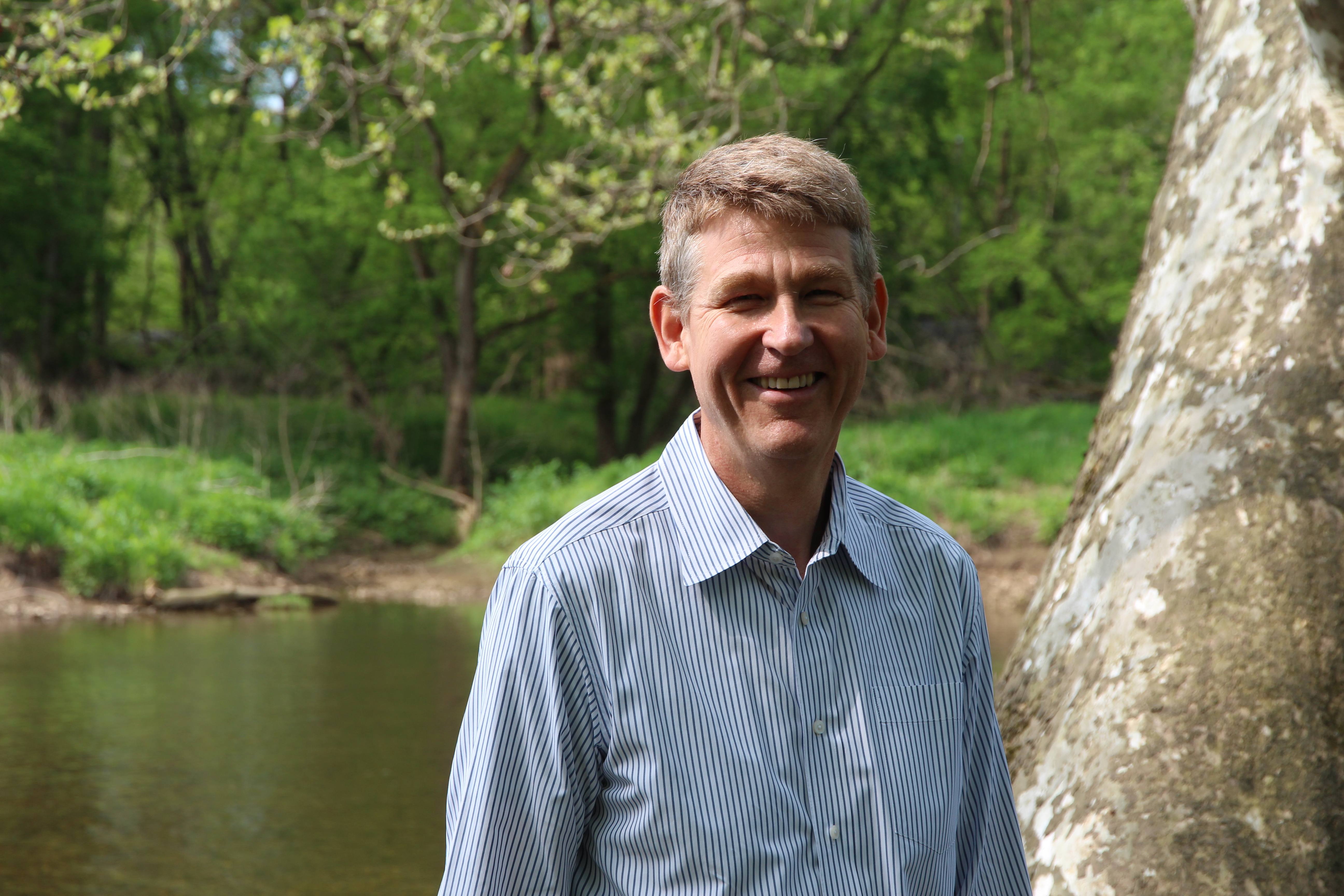
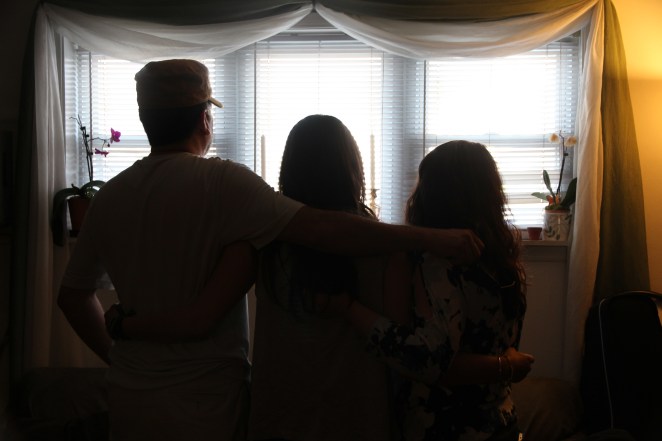
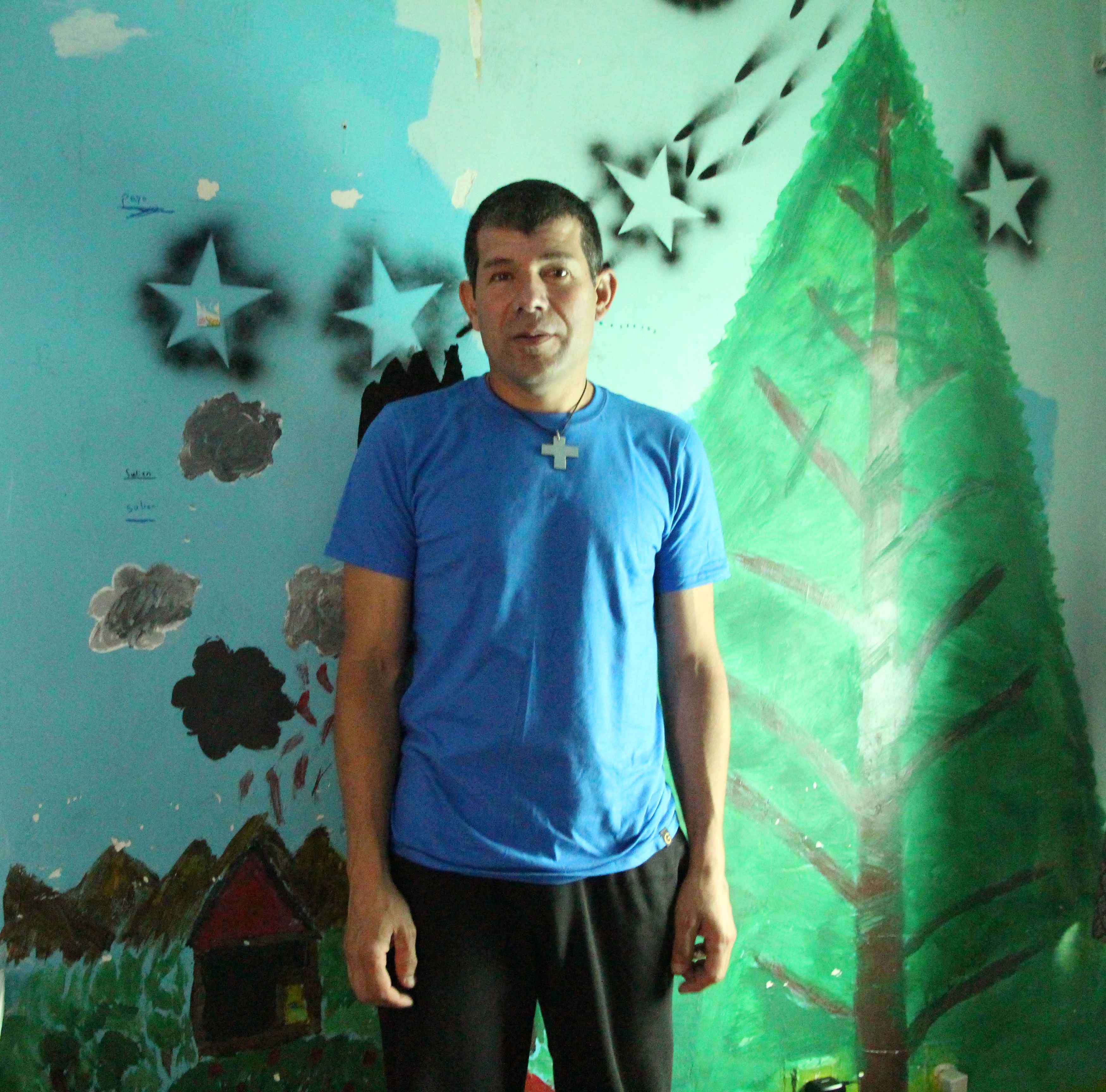
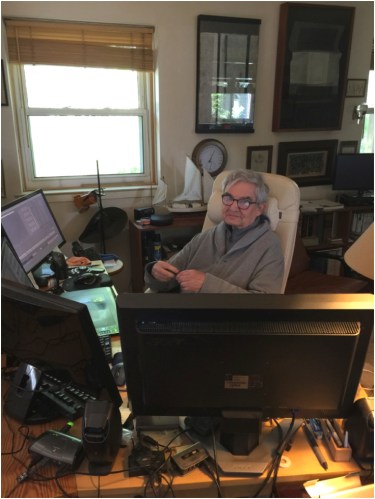
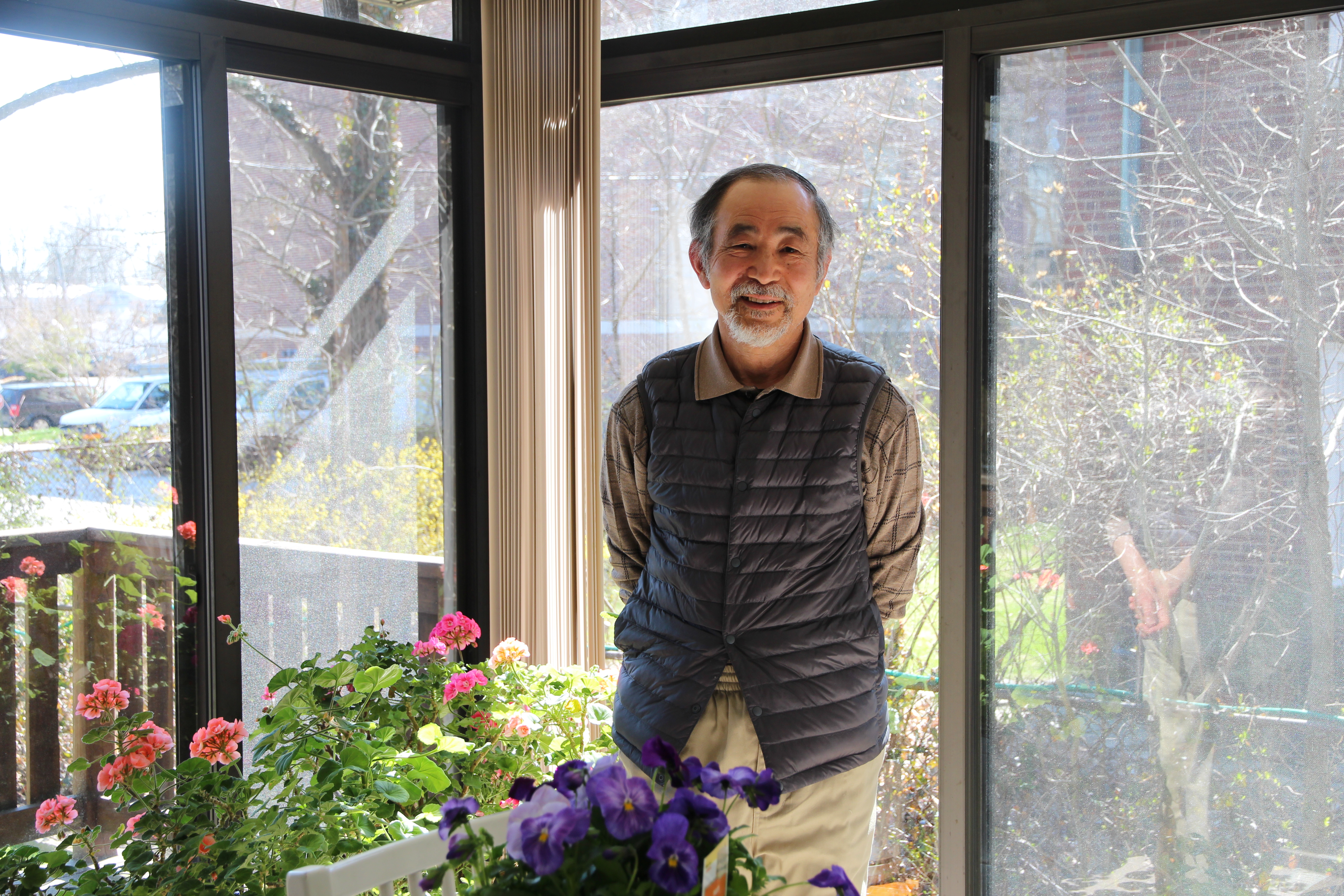
Portrait of Dani

Dani is the only member of her family born in the US, and therefore the only one who can travel freely. She is nine years old.

32. IMG_0416Last summer I went to Ecuador for five weeks by myself to visit my family there. I met them by video chat first. I went to Ecuador after my grandma came here for my first communion, when she styed with us for three weeks. That visit was the first time I had met her.

When I arrived in Ecuador, first I stayed at my aunt’s in Guayaquil. I felt strange because I never seen their house in pictures before. It was this big house in a gated community with guards, I didn’t think they had this lifestyle in Ecuador. And when I saw my grandparents house I was surprised because I didn’t think they were going to be big, but they were. I thought they were very pretty. I didn’t have a picture in my head of what Ecuador looked like. I liked it there, it was a good, small place because all of my family lived there.

It was my first time away from home, and the first three days I cried and said I want to come home, I didn’t want to be away from my parents and sisters. But at the end I wanted to stay longer. I was happy to be with my grandparents, aunts and uncles, and to meet all my cousins.

Angie and Maria always tell how when they were little they didn’t wait for our mother or grandmother to make food, they made it themselves.

I like hearing the stories Angie and Maria tell me about when they were little and lived in Ecuador because I am able to learn more about my family. I learned that Maria and Angie lived with my grandma for a couple of years while my parents worked in the United States. It makes me sad to hear that because they were away from our parents for years while I get to spend every day with them. I would feel sad if it happened to me. But I know my grandma helped my sisters stay strong because she’s like our second mother. I do like hearing stories about our parents working here because it helps me understand what they sacrificed for us to give us opportunities and a better life.

Photo by Jennifer Baker

Spanish Translation by Elizabeth Pascual


Dani

(Dani es la única persona de su familia nacida en los Estados Unidos y por lo tanto ella es la única que puede viajar libremente. Ella tiene 9 años de edad.)

El verano pasado fui a Ecuador solita por cinco semanas para visitar a mi familia. Los conocí por video chat primero. Fui a Ecuador después de que mi abuela había venido aquí para mi primera comunión. Durante ese tiempo ella se quedó con nosotros por tres semanas. Esa visita fue la primera vez que la conocí.

Cuando llegué a Ecuador, al principio me quedé en casa de mi tía en Guayaquil. Me sentí extraña porque nunca antes había visto su casa en fotos. Era una casa grande en una comunidad cerrada con guardias, no creía que tuviera ese estilo de vida en Ecuador. Cuando vi la casa de mis abuelos me sorprendí porque no pensaba que iba a ser grande, pero sí lo era. Pensé que eran muy bonitas las casas. Yo no tenía una imagen en mente de lo que Ecuador parecería. Me gustó estar allí, es un lugar pequeño y bonito además porque toda mi familia vive allí.

Era mi primera vez fuera de casa, y los tres primeros días lloré y quería volver a casa, no quería estar lejos de mis padres y hermanas. Pero al final quería quedarme más tiempo. Estaba feliz de estar con mis abuelos, tías y tíos, y de conocer a todos mis primos.

Angie y Maria siempre dicen que cuando eran pequeñas no esperaban a que nuestra madre o abuela cocinaran, se cocinaban solas.

Me gusta escuchar las historias que Angie y Maria me cuentan decuando eran pequeñas y vivían en Ecuador porque así aprendo más sobre mi familia. Aprendí que María y Angie vivieron con mi abuela por un par de años mientras mis padres trabajaban en los Estados Unidos. Me entristece oír eso porque estaban lejos de nuestros padres durante muchos años mientras yo pasaba todos los días con ellos. Me sentiría triste si eso me ocurriera. Pero sé que mi abuela ayudó a mis hermanas a mantenerse fuertes porque ella es como nuestra segunda madre. Me gusta escuchar historias sobre nuestros padres y como han trabajado duro aquí porque me ayuda a entender lo que sacrificaron para darnos oportunidades y una vida mejor.

Portraits of People on the Move tells the stories of Philadelphia-area immigrants through their own words on the Supperdance.com blog and was first shown as an exhibition in June 2015, at the Gray Area of Crane Arts in Philadelphia. The exhibition was created as a companion work to Supper, People on the Move by Cardell Dance Theater, a dance inspired by themes of migration.

Portrait of Kamau Kanyi

“The decision to stay here was not a straight line. I still ask myself where I am most helpful.”

Kamau Kanyi works in foster care and adoption services.

23. KKPrior to coming to America in 1997, I was enjoying working in public relations at a college in Nairobi, Kenya. Coming to America was an opportunity for academic and professional credentials.

Also, my girlfriend came to Philadelphia area in 1996. I came to go to school and to be with her. I moved to New Jersey and went to Rowan University. I graduated in 1999 with a masters degree in public relations. My girlfriend and I went back to Kenya at the end of 1999 to get married and then came back together to gain professional experience. I decided to go back to school again to keep legal status and continue gaining professional experience.

I went to the doctoral program at Rowan University in 2000 where I also worked as a research assistant, and graduated in 2009. In 2003, I got a job with a non-profit organization doing community relations. I am still at the same organization, which provides foster care and adoption services for children and families in the Philadelphia area. My wife and I first had work visas, then applied for green cards. We are now beginning the application for citizenship, which takes five years after getting the green card.

Do I feel pulled by two different cultures? I had an open mind to going back to Kenya, but the experience of settling here was difficult and lengthy. The process of maintaining legal status on a work visa before the green card was also long and expensive. The decision to stay here was not a straight line. I still ask myself where I am most helpful. Being in both cultures is a balancing act—living here and being of help back home. I try to help organizations and individuals back home, especially with fund raising. It is a healthy tension.

I remember the day I left home very clearly—imprinting the memory of my family.  Coming here, I was leaving my mum, dad, older sister, older and younger brothers, as well as my extended family. I was also leaving my many friends, beloved country and life as I knew it. That was very difficult and heart-throbbing.  My last day before leaving home was quite hectic. Farewells to family, following up on last minute packing and details, etc. and then be at the airport for a 3am flight. On the other hand, I was going to see my girlfriend that I had not seen for a year. There was also opportunity to grow together academically, professionally, and to begin a family together.

My wife and I have two kids now, nine and thirteen. We went back home last summer with our kids. As always, it was awesome to reconnect with family again. Yes, coming to America was worth it. For me this has been one of God’s many miracles. And this story is not finished yet—I am full of hopefulness for the future.

Portraits of People on the Move tells the stories of Philadelphia-area immigrants through their own words on the Supperdance.com blog and was first shown as an exhibition June 25–28, 2015, at the Gray Area of Crane Arts in Philadelphia. The exhibition was created as a companion work to Supper, People on the Move by Cardell Dance Theater, a dance inspired by themes of migration.

Portrait of Andrew Stewart

“When I’m there, it’s like I never left. It’s a nice thing to have.”

Andrew Stewart is the director of marketing and communications at the Brandywine Conservancy & Museum of Art

47. IMG_0504Photo by Jennifer Baker

I think I had wanderlust from an early age. I came here from Linlithgow, a small town near Edinburgh, Scotland. Linlithgow’s main claim to fame is that Mary Queen of Scots was born there. It’s a gorgeous little town. My father was a mechanic, my mother was trained as a nurse, but stayed home with four children. My dad dreamed of going somewhere different like me but my mother didn’t want to go anywhere. I grew up thinking, I wish something would happen, something exciting. I have two brothers and one sister. They’re all still in Scotland. I had an unremarkable childhood. I always felt Scotland wasn’t right for me. I graduated high school in 1978 when there was a terrible collapse of the economy and a prolonged recession. Thatcher was elected in 1979, she was hated in Scotland, and she pretty much dismantled the traditional industries in Scotland, so there was very high unemployment.

I was training to be an electrician. I went through an apprenticeship, but there was no work so I was unemployed for a while after I finished up my training. Eventually, I ended up finding a job, working in power plants. It was pretty interesting. I worked in the Shetland Islands for a while. I made some friends and one of them had been to Israel. He had bought a motorcycle and taken it to Israel and sold it for enough to pay for the trip. So we bought some motorcycles in London and took them to Israel. It took about six weeks to get there. I was interested in working on a kibbutz, I liked the idea of a socialist communal farm, and I ended up staying there about ten months. It was amazing to me. We were picking avocados and bananas, things you didn’t see growing in Scotland. I loved it. About three or four months in, I met this American girl and we started getting involved with each other. After leaving the kibbutz we ended up in London. We both found jobs immediately and it was a great summer.

In the meantime, I got a well-paid job in Scotland at a nuclear power station. So at the end of the summer, she went back (to the US) and I went to Scotland. I really missed my girlfriend. I had been at this new job three or four months and I asked for a leave of absence and I went to visit my girlfriend. She was at Barnard College in Manhattan, living in a dorm. I never left. I never went back to Scotland. I came over for a vacation and I just never went back. So that’s how I came to America. I came on a tourist visa.

I had to sneak into the dorms every single day. A friend got me a job with two Greek brothers who were installing siding on houses in Westchester County just outside New York City and we’d go up there every day to work. After my girlfriend graduated, we got an old car and drove across the country to Santa Cruz, California, where we both found work. Nobody cared about your work papers at that point, especially if you were white. They weren’t asking where you were from. I think I made up a social security number. The thing that scared me was the Selective Service. They got my address and started sending me letters asking why I had not registered with them and I eventually got a letter in an FBI envelope which I didn’t open. I was paying taxes. I just kept on working illegally until we decided to get married. After that, I came clean with the government and got a green card. Subsequently I became a citizen, when my first child was born. I decided I was here for good, I might as well participate and vote. I’ve lived here now more than half my life.

There was a big earthquake close to where we lived in 1989 which freaked out my wife to the point that she stopped sleeping. Then her dad, who had heart bypass surgery about ten years before, dropped dead one day. Shortly after that, her mother had a recurrence of cancer. So we moved back to New Jersey and lived with her mother until she passed. It was a good opportunity for me to go back to school. I went to Rutgers. I studied history and political science. Very useful. I got a job working in advertising and after that I worked for the Franklin Mint, from 1995 to 2000. I got really interested in museums and ended up working for the Barnes Foundation.

I go back to Scotland once or twice a year. It’s always been a priority of mine to go back. I feel like I didn’t ever really say goodbye. And I love going there in the summer. When I was married and the kids were young, we’d all go over. The first thing we did when the babies got home from hospital was to get them passports.

I loved coming to the US. My first impression of New York? It reminded me of TV from my childhood. Starsky & Hutch, Kojak, Taxi. I remember coming here and realizing that car tires here made squeely noises. I used to think it was just sound effects on the American TV and movies I watched as a kid, but it really happens. You come here, and there are giant cars everywhere, and big roads, and all those people in Manhattan, millions upon millions. There are more people in New York than in my whole country. So just the feeling of being around all those people all the time was so different and so interesting for me. I used to question everything here for about the first year. Then I stopped doing that, or at least I learned to keep it to myself. I questioned the politics, and lots of silly stuff, like why are people driving automatic cars instead of stick-shifts. I remember people saying why do you question everything. When I first came over people would realize I was not long here and more than a few times people said to me that I must be so glad to be here and be free. I’d just laugh.

I feel very American at this point. I mean, I do think of myself as Scottish and obviously with the current political situation in Scotland, I’m very interested in what goes on there, but culturally I definitely feel more American than Scottish. Although being from Scotland does give me a different point of view. The whole debate in this country about having medical care available for everyone is an example. For me it was like, huh? You have to have a job to get medical insurance? We just had access to medical care for everyone in Scotland and my generation never gave it a second thought.

Could I have made a life in Scotland? Sure. I look back at the time when I was unemployed and I remember that I really felt hopeless. It was a dreadful time in Scotland. I go back now and it feels very different. Many of my friends have successful careers and have moved back to Linlithgow because it’s really an ideal town. My parents still live there and when I go back I stay with them. My two brothers are there also and my sister lives in Glasgow which is nearby. It’s really wonderful to go back. And lots of my friends are around. Two very close friends, one was the best man at my wedding, live a five minute walk from my parent’s house. I go back and it’s just all there. I love it. When I go home, I’m very much at peace. When I’m there, it’s like I never left. It’s a nice thing to have.

Portraits of People on the Move tells the stories of Philadelphia-area immigrants through their own words on the Supperdance.com blog and was first shown as an exhibition in June 2015, at the Gray Area of Crane Arts in Philadelphia. The exhibition was created as a companion work to Supper, People on the Move by Cardell Dance Theater, a dance inspired by themes of migration.

Portrait of J.C.

“The most important thing to do in my life is to stay with my family.”
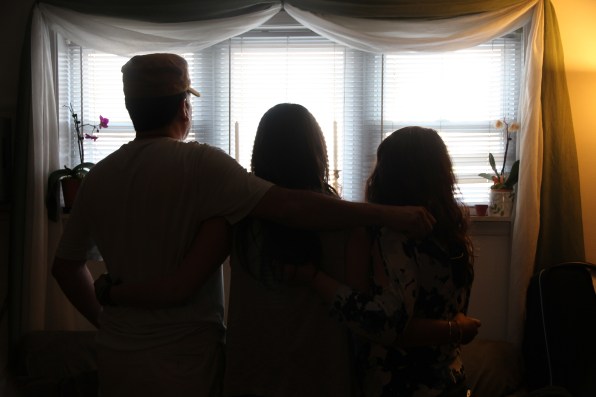
28 and 29. IMG_0402Photo by Jennifer Baker

The first time I came to the US, the travel part was easy. That was 13 years ago. The first year in America was very difficult. I came here in 1998, like everyone, looking for opportunity. I had a brother here, and he helped me to find a job. I got a tourist visa and flew to New Jersey from Ecuador. My first impression: it was very exciting but I was also afraid. The buildings, the construction of houses, were so beautiful. I thought I would stay here for one year, maybe two. I missed my daughter and my wife. When my wife came a few months later, I was very happy to have her with me.

Just before I left home, I played soccer with my friends. My best friend stopped playing, called all my friends so I could say goodbye to them. At night, I had dinner with my parents and got everything ready for travel. At 10am, I took a bus to the airport. My daughter and wife came to see me off.

After four years in the US I went back home to renew the visa. They told me I could renew it after six months. I prepared the visa paperwork and then they say no. I waited another six months. I went back again and again they said no. That was one year in Ecuador. I needed to go to the US—my family was there.

A friend convinced me to start looking for contact for coyote. Somebody says, take this phone number, call it, one person says it will be ten grand, the other person says it will be $5,000. Go to Mexico City then call again. It was $5,000. I don’t know how the system is, I don’t know how to travel through Honduras, Guatemala, into Mexico. So I go to the Mexican consulate, apply for a visa and get approved. I fly from Ecuador safely into Mexico. I was a very lucky man.

The next week I flew to Mexico City. I was afraid; this was very risky. I had a reservation in a hotel. I called the coyote. He picked me up and we went to a big house. There were twenty people waiting, everyone afraid. I had opened up the seam in my shoe and hid my money inside. The coyote said it would be 1,000 dollars.

I take one change of clothes and gave away everything else. We travel by bus with the old guy (the coyote). Army guys pull over our bus and ask the driver if there is anyone suspicious. My heart is pounding; it was 11 or 12 at night. He lets us go. At 2am we are stopped again, everyone is sleeping. Another three or four hours, one more stop. In the morning at 10 or 11, immigration control stops the bus again and asks for identification. I tried to stay asleep. The old guy says, “He’s sleeping, he’s got a stomach ache.” I pretend to be really sleepy and get down my bag. He says, “It’s ok don’t bother.” That was good luck. The old guy says, “This is my job.”

There are five of us, we cross the river at night, it is very dark. There’s an inner tube just for the girl. We each have trash a bag to carry our shoes and everything. It is maybe 30 meters across. We are told, “Be very quiet, put on your shoes and do what I say.” We stop, see the lights of a police car, go a different way, across fields. Then crawl through bushes for a couple of hours. We are told someone will pick you up in two or three hours.

We finished crawling through the bushes at dawn. We see a patrol car. We stop at a gas station. The guy tried to use his phone but there is no reception. Nobody had American coins, only pesos. When the gas station opens, we can buy something to get change to use the payphone. We stay in bushes to wait for day. I was not going to take my money out of my sneaker to make a phone call. Finally he is able to call and we are told the car will be here in ten minutes. We get in the car and are told to stay down. They leave me and one other guy in a house. There is no food. We are hungry and want to take showers. I tell him to bring me food. Next day again, there’s no food. I go out myself this time and find a store to buy food and bring it back to share with the other guy.

After two days, they pick us up to go to a big house where there were about 30 people mostly from Central America and Mexico. At night, we all get in pickup trucks and lie down so no one can see. They stop outside of the city and everyone gets out. They say, this is the coyote, do what he says. We try to walk around the police stations. We walked early morning and very late, in the daytime we stayed still. We each have one water bottle, a little container with sweet potato, corn and beans—that’s it. Everyone was very tired. After walking for two or three days, another truck picks us up and takes us to a bus station. We all bought tickets to different places. I bought a ticket to Philadelphia and I was here in two days.

It was quite an experience. I had good luck. I was outside the house. I go to the back door and looked through the window. I saw my daughter, and my niece too. They knew I was coming but not when. They were afraid. I said, “It’s dad, open up.” My heart was so happy.

I try to find a job. I don’t have many contacts, not like the first time. I find a job working in a pizza shop. I work cleaning banks at night, and I work construction. I do construction 8 to 4 in Philadelphia, then go back home to take a shower. At 5pm I go to my pizza job. At 11pm I go to a different place for my cleaning job. I get home at 2am. Next day is the same. Children are asleep. Sunday I have more time. Sunday I work in the pizza shop, but only one job that day. After one year I just did the pizza shop and construction work. I try to stay under the radar.

My daughters grew up very fast. They finished high school and college too. I might want to go back someday. But the most important thing to do in my life is to stay with my family.


J.C., de Ecuador

La primera vez que vine a los Estados Unidos, la parte del viaje fue fácil. El primer año fue muy difícil. Llegué en 1998, como todos, buscando una oportunidad. Tenía un hermano acá y él me ayudo a conseguir un trabajo. Obtuve una visa de turista y volé de Ecuador a Nueva Jersey. Mi primera impresión fue que todo era muy emocionante, pero también estaba asustado. Los edificios, las construcciones de las casas, todo era hermoso. Pensé que me quedaría un año, tal vez dos. Extrañaba a mi hija y a mi esposa. Cuando mi esposa llegó, un par de meses después, estaba muy contento de tenerla conmigo.

Antes de irme de mi hogar, jugaba fútbol con mis amigos. Mi mejor amigo dejó de jugar, y llamó a los demás para que yo pudiera despedirme. A la noche, cené con mis padres y preparé todo para viajar. A las 10 de la mañana, tomé el autobús hacia el aeropuerto. Mi hija y esposa vinieron a despedirme.

Luego de 4 años en los Estados Unidos, volví a casa a renovar la visa. Me dijeron que podría renovarla luego de seis meses. Preparé el papeleo para la visa y me la rechazaron. Esperé otros seis meses más. Volví a ir y la volvieron a rechazar. Ese fue un año en Ecuador. Tenía que volver a los Estados Unidos, mi familia estaba allí.

Un amigo me convenció de empezar a buscar el contacto de un “coyote”. Alguien me dio un número y me dijo que llamara. “Algunos dicen que cuesta 10 mil, y otros, 5 mil”. Ve a Ciudad de México y vuelve a llamar. Fueron $5.000. No sé cómo es el sistema. No se cómo viajar por Honduras y Guatemala hasta México. Así que voy al consulado mexicano, aplico para una visa y me la aprueban. Volé desde Ecuador de manera segura hasta México. Tuve mucha suerte realmente.

A la semana siguiente, volé hasta Ciudad de México. Tenía miedo, era muy riesgoso. Tenía una reserva en un hotel. Llamé al “coyote”. Pasó a buscarme y fuimos a una gran casa. Allí había 20 personas esperando, todas asustadas. Había abierto la costura en mi zapato y escondí mi dinero adentro. El “coyote” dijo que serían $1,000.

Tomé una muda de ropa y regalé todo lo demás. Viajamos en autobús con el viejo (el “coyote”). Los tipos del ejército detuvieron el autobús y le preguntaron al conductor si alguien allí era sospechoso. Mi corazón latía fuerte; eran las 11 o 12 de la noche. Nos dejó ir. A las 2 de la mañana paramos nuevamente, todos dormían. Otras dos o tres horas, y otra parada. A la mañana, a las 10 u 11, el control de inmigraciones detiene el autobús nuevamente y pide identificaciones. Intenté quedarme dormido. El viejo dice: “Él está durmiendo, tiene dolor de estómago”. Fingí estar muy somnoliento y bajé mi bolso. Él dijo: “Está bien, no te preocupes”. Eso fue buena suerte. El viejo me dijo: “Este es mi trabajo”.

Éramos cinco cruzando el río de noche, estaba muy oscuro. Había un tubo interno solo para la chica. Cada uno tenía una bolsa de basura para llevar nuestros zapatos y todo lo que teníamos. Habíamos cruzado unos 30 metros. Nos dijo: “Sean muy silenciosos. Pónganse sus zapatos y hagan lo que les digo”. Nos detuvimos cuando vimos las luces de un auto de policía, y fuimos hacia otro lado, a través de campos. Luego nos arrastramos a través de los arbustos durante algunas horas. Nos dicen que alguien vendrá a buscarnos en dos o tres horas.

Nos arrastramos a través de los arbustos hasta el amanecer. Cuando logramos salir de los arbustos, vimos una patrulla. Decidimos parar una estación de servicio. El tipo intentaba usar su teléfono, pero no había señal. Nadie tenía monedas americanas, solo pesos. Cuando abrió la estación de servicio, logramos comprar algo para tener cambio y usarlo en la cabina telefónica. Esperamos escondidos en los arbustos durante el resto del día. No iba a sacar los $100 que tenía en mis zapatillas por una llamada telefónica. Finalmente, él logró hacer la llamada y nos avisó que el auto llegaría en 10 minutos. Nos metimos en el auto y nos pidieron que nos agacháramos. Me dejaron a mí y a otro tipo en una casa. No había comida. Teníamos hambre y queríamos tomar una ducha. Le pedí que trajera comida. Al día siguiente, aún no teníamos nada para comer. Esta vez salgo yo mismo y encuentro una tienda para comprar comida y llevarla a la casa para compartirla con el otro chico.

Dos días después, nos recogieron para ir a una casa grande donde había unas 30 personas, la mayoría de América Central y México. A la noche, nos metieron a todos en camionetas y nos hicieron recostar para que nadie pudiera ver. Ellos paraban en las afueras de la ciudad y todos se bajaban. Nos dijeron: “Este es el ‘coyote’, hagan lo que les dice”. Intentábamos evitar las estaciones de policía. Caminábamos temprano por la mañana o por la noche, y durante el día nos quedábamos quietos. Cada uno de nosotros tenía una botella de agua, un pequeño recipiente con batata, maíz y frijoles… y eso era todo. Todos estábamos muy cansados. Después de caminar durante dos o tres días, otro camión nos recogió y nos llevó a una estación de autobuses. Todos compramos boletos a lugares distintos. Yo compré un boleto a Filadelfia y me quedé allí por dos días.

Fue toda una experiencia. Tuve buena suerte. Estaba afuera de la casa. Me acerqué a la puerta trasera y miré por la ventana. Estaba mi hija, y también a mi sobrina. Sabían que volvería, pero no sabían cuándo. Estaban asustadas. Dije: “Es papá, abre”. Mi corazón saltaba de alegría.

Intenté buscar un trabajo. Pero no es como la primera vez, porque ya no tengo muchos contactos. Encontré trabajo en una pizzería. Trabajo limpiando bancos por la noche, y trabajo en la construcción. Trabajo en la construcción de 8 a 4 p. m. en Filadelfia, y luego vuelvo a casa para tomar una ducha. A las 5 p. m., voy a la pizzería. A las 11 p.m., salgo y voy a otro lugar para mi trabajo de limpieza.  Vuelvo a casa a las 2 de la mañana. Todos los días son iguales. Los niños duermen. Los domingos tengo más tiempo. Los domingos trabajo en la pizzería, pero solo hago ese trabajo. Intento pasar desapercibido. Mis hijas crecieron muy rápido. Terminaron la escuela secundaria, y también la universidad. Tal vez quiera volver algún día. Pero lo más importante para mí es quedarme con mi familia.

Portraits of People on the Move tells the stories of Philadelphia-area immigrants through their own words on the Supperdance.com blog and was first shown as an exhibition June 25–28, 2015, at the Gray Area of Crane Arts in Philadelphia. The exhibition was created as a companion work to Supper, People on the Move by Cardell Dance Theater, a dance inspired by themes of migration.

Portrait of Maria

“I was going to be a doctor at home. Here I clean houses. But if you allow yourself to be depressed you will be.”

28 and 29. IMG_0402

Photo by Jennifer Baker

I was in college studying medicine in Ecuador. My first daughter had been born prematurely, and when I was pregnant with my second daughter the doctor said I had to stay in bed for one and a half months. Two weeks before she was born, I suffered facial paralysis that lasted for seven months. I lost a lot of time not being in classes.

The next year I tried to go back to college but they had changed from a traditional system to a modular system. I had 5 years of study, but I would have to go back to the second module. I could move to a different city with a university with a traditional system, or start over where I was. I thought of starting a business, and applied for jobs. I knew how to use a computer so I ended up working as a secretary for five years. That was when my husband decided to come here. The idea was to have a house one day, to earn money for one or two years and return.

Six months later I decided to come join him. I came here April 24, 1999, a Saturday. My daughters stayed with my mother in Ecuador for three years. When I entered the US I was given six months to stay. I got a job in a box factory, cutting sponge for packaging. I worked four days the first week and was paid $200. It was more than I would have made in a month back home. I lived in an apartment with my husband and my brother and sister in law. It took two weeks work to earn our living expenses, rent and food, and then the rest we could save. I worked there only two weeks. My sister-in-law was cleaning houses and schools. She was leaving to go back to Ecuador and told her boss that I would take over her job. But she lied to me—I thought it was a full time job, but it was only two houses.

The people I worked for thought I didn’t know any English at all because I didn’t talk much. For two months I listened to the husband calling me stupid idiot and saying why do you pay her so much? The woman made me coffee one day and was trying to teach me to say “su-gar,” talking to me like a small child. One day I was tired and the husband dropped me off. I say, “thank you so much have a nice weekend,” and he was shocked. Why don’t you tell me you speak English? Your sister-in-law said you only know how to say hello. I explained that I know more but when you are learning a new language you are afraid to speak. They were very sorry, and after that they were really nice with me and with my daughters when they came, and helped me find more jobs.

In 2002 we went back for our daughter’s first communion. We got both our daughters visas and decided to bring them back to the U.S. with us. We tried to enroll our daughters in school. We brought the papers to the school district. They took our passports. We will let you know which school and which grades your daughters will be in. They were assigned to second and fourth grade. In my country they were in fifth grade and seventh grade. I was asked to go talk to someone at the school district. The lady had noticed my daughters had a visitor’s visa, she became angry, screamed at us and said your daughters don’t have the right to be here. I was told by her, “If you try to have them in this school, I will call immigration.” And she would not give us our papers back. That was the only time I thought that we should go back to my country. So we tried a Catholic school. The first one would not take them because they didn’t have a teacher who could teach them English. So we tried another school, and they said they could take them. They would spend the first year just to learn English, and they would be in grades 3 and 5. The principle said that to put them in the grades that they were in at home would be like putting lambs in a pack of wolves. This turned out to be the right decision. The culture is different here and girls that age in Ecuador are still children.

We had a party when I was leaving, with food and family. My mother’s family had a big barbecue with friends, aunts, and cousins. We had barbecue meat, corn on the cob, potatoes, and yucca. My friends brought chicken and rice. There was lots of food, lots of meat, and lots of friends. We were celebrating because I was going to be with my husband. My girls called my sister’s house at 5am to say goodbye. My father-in-law came with me to the airport. I flew to Newark and took a train to Philadelphia.

While my husband was away in my country (he went back to renew visa) I couldn’t pay anyone to take care of the girls while I was at work, so they stayed alone. They had to grow up fast. One would cook. The other would clean. They were 9 and 10. I got home from work at midnight. They made dinner and left it for me each night. They cooked rice with eggs and cheese. I was afraid for them to cook. I had to buy cell phones. They called me and asked me how to cook soup, and I had to explain potato soup over the phone. This was in the summer and they were all day at home. One thing I will never forget, on my birthday they made brownies for me in a Daisy Bake Oven. They went to the supermarket and made a cake and brought it to me at 5 am before I went to work.

Work here is difficult. Everyone comes, wants a good job, good luck, and someone to help. I can’t say anything bad. It’s hard work but I can help my daughters. The girls have made opportunities here.

I was going to be a doctor at home. Here I clean houses. But if you allow yourself to be depressed you will be. I belong to an organization, Centre de Apoyo Communitarios. We work with Villanova students to help community members open ITINs (Individual Taxpayer Identification Number) and file taxes; we also help people with ESL (English as a Second Language) classes. We hope to hold trainings about domestic abuse very soon. Helping others makes me feel more worthwhile.


Maria

Yo estaba en la universidad estudiando medicina en Ecuador. Mi primera hija había nacido prematura, y cuando estaba embarazada de la segunda, el doctor me dijo que tenía que hacer reposo durante un mes y medio. Dos semanas antes de que naciera, sufrí una parálisis facial que duró siete meses. Pasé mucho tiempo sin ir a clases.

Al año, intenté volver a la universidad, pero habían cambiado el sistema tradicional por uno modular. Tenía 5 años de estudios, pero tendría que regresar al segundo módulo. Podía mudarme a una ciudad distinta con alguna universidad con un sistema tradicional, o volver a empezar en donde estaba. Pensé en comenzar un negocio y me postulé a distintos trabajos. Sabía cómo usar una computadora, así que termine trabajando de secretaria durante cinco años. Ahí fue cuando mi esposo decidió venir aquí. La idea era conseguir una casa, ganar dinero por uno o dos años y volver.

Seis meses después, decidí venir con él. Llegué aquí el 24 de abril de 1999, un sábado. Mis hijas se quedaron con mi madre en Ecuador durante tres años. Cuando entré a los Estados Unidos, me dieron seis meses para quedarme. Conseguí un trabajo en una fábrica de cajas, cortando esponjas para empacar. Trabajé cuatro días en la primera semana y me pagaron $200. Era más de lo que hubiese ganado en un mes allá en casa. Vivía en un departamento con mi esposo, mi hermano y mi cuñada. En dos semanas de trabajo, ganábamos para nuestros gastos de subsistencia, alquiler y comida, y luego el resto podíamos ahorrarlo. Trabajé allí solamente dos semanas. Mi cuñada trabajaba limpiando casas y escuelas. Ella se marchaba para regresar a Ecuador y le dijo a su jefe que yo tomaría su puesto. Pero me mintió. Yo creía que era un trabajo de tiempo completo, pero eran solo dos casas.

La gente para la que trabajaba pensaba que yo no sabía nada de inglés porque no hablaba mucho. Durante dos meses escuché al esposo llamarme “estúpida idiota” y preguntándole a su esposa: “¿Por qué le pagas tanto?”. La mujer me hizo café un día e intentó enseñarme a decir “su-gar”, hablándome como a una niña pequeña. Un día estaba agotada, y el esposo me llevó a casa. Le dije: “Muchas gracias. Que tenga un buen fin de semana” en inglés y se quedó muy sorprendido. “¿Por qué no me dijiste que hablas inglés? Tu cuñada dijo que solo sabías saludar”. Le expliqué que sabía decir más cosas, pero que cuando uno aprende un nuevo idioma le da miedo hablar. Se sintieron horrible, y después de eso fueron muy amables conmigo y con mis hijas cuando vinieron, y me ayudaron a encontrar más trabajos.

En 2002, volvimos para la primera comunión de nuestra hija. Les conseguimos visas a nuestras hijas y decidimos traerlas a los Estados Unidos con nosotros. Intentamos anotarlas en la escuela. Llevamos los documentos al distrito escolar. Y se quedaron con nuestros pasaportes. “Les informaremos la escuela y a qué grado irán sus hijas”. Las colocaron en segundo y cuarto grado. En nuestro país, ellas estaban en quinto y séptimo grado. Me pidieron que fuera a hablar con alguien en el distrito escolar. La señora se dio cuenta de que mis hijas tenían visas de turista. Se enojó y grito: “¡Sus hijas no tienen derecho de estar aquí!”. Me dijo: “Si intentan traerlas a esta escuela, llamaré a Migraciones”. Y no nos devolvía nuestros papeles. Esa fue la única vez que pensé que deberíamos volver a nuestro país. Así que intentamos en una escuela católica. La primera no las tomaría porque no tenían un maestro que pudiera enseñarles inglés. Así que intentamos en otra, y nos dijeron que las tomarían. Pasarían el primer año solamente para aprender inglés y estarían en tercero y quinto grado. El director dijo que ponerlas en los grados en los que estaban en casa sería como poner corderos en una manada de lobos. Terminó siendo la decisión correcta. La cultura es distinta aquí, y las niñas de esa edad en Ecuador siguen siendo solo niñas.

Tuvimos una fiesta cuando me iba, una comida en familia. La familia de mi madre tuvo una gran barbacoa con amigos, tías y primos. Comimos carne asada, maíz en mazorca, patatas y yuca. Mis amigos trajeron pollo y arroz. Había mucha comida, mucha carne y muchos amigos. Estábamos celebrando que finalmente estaría con mi esposo. Mis hijas llamaron a la casa de mi hermana a las 5 de la mañana para despedirse. Mi suegro me acompañó al aeropuerto. Volé a Newark y tomé un tren a Filadelfia.

Como mi esposo estaba afuera, en mi país (para renovar la visa), y no podía pagarle a nadie para que cuidara a las niñas mientras yo estaba en el trabajo, se quedaron solas. Tuvieron que crecer rápido. La mayor cocinaba, y la menor limpiaba. Tenían 9 y 10 años. Yo llegaba del trabajo a casa a medianoche. Ellas preparaban la cena cada noche, y me dejaban un plato para que yo comiera. Cocinaban arroz con huevos y queso. Me daba miedo que cocinaran. Tuve que comprarles teléfonos celulares. Me llamaban y me preguntaban cómo preparar sopa, y yo tenía que darles por teléfono la receta para hacer sopa de papas. Esto fue en el verano y se quedaron todo el día en casa. Algo que nunca olvidaré es que en mi cumpleaños me prepararon unos brownies en su horno para niños. Fueron al supermercado, me hicieron un pastel y lo me lo trajeron a las 5 de la mañana antes de que partiera para el trabajo.

Es difícil el trabajo aquí. Todo el mundo viene, quiere un buen trabajo, buena suerte y alguien para ayudar. No puedo quejarme. El trabajo es duro pero me permite ayudar a mis hijas. Las niñas han tenido oportunidades aquí.

En mi país, yo iba a ser médica. Aquí limpio casas. Pero si le das lugar a la depresión, ahí te quedarás.Pertenezco a la organización Centro de Apoyo Comunitario. Trabajamos con estudiantes de Villanova para ayudar a los miembros de la comunidad a sacar sus ITIN (es decir, su número de identificación individual del contribuyente) y declarar impuestos; y también ayudamos a la gente con sus clases de inglés como idioma extranjero. Esperamos realizar capacitaciones sobre abuso doméstico muy pronto. Ayudar a los demás me hace sentir más valiosa.

Portraits of People on the Move tells the stories of Philadelphia-area immigrants through their own words on the Supperdance.com blog and was first shown as an exhibition June 25–28, 2015, at the Gray Area of Crane Arts in Philadelphia. The exhibition was created as a companion work to Supper, People on the Move by Cardell Dance Theater, a dance inspired by themes of migration.

Portrait of Prudence Powell

“If I had a chance to go back I’d hug my mom who I have not seen for twenty years.”

41. IMG_0441Photo by Jennifer Baker

I came from Jamaica when I was twelve years old on February 21, 1995. I didn’t have a choice. My dad and aunt decided that it was better for me to be here. School was free here and they were tired of paying for me to go to school in Jamaica and me not doing very well. They decided that I should come to the US and live with her in New York. I came in the plane by myself. I didn’t start school until mid March because they needed information and papers to make sure my mom was okay with my being here. She finally got me in school but it took a lot of work. While I was going to school I was teased and picked on. I was different. I was quiet and I had an accent and didn’t talk like the rest of the kids. When it was almost time for graduation, everyone was filling out what school they want to go to. I was asked where’s your social; I asked my aunt about it and she brushed it off, said you don’t need that. I was not aware that my visa had expired after six months. I had a visitor’s visa and I had overstayed. My aunt could have renewed it or got me permanent residency, but she didn’t. I was sixteen and I got pregnant and dropped out of high school. I knew I couldn’t go to college and I had no hope. I had no social security number so I couldn’t get financial aid. My aunt didn’t renew my visa, she said she didn’t have the money, but really she chose not to. She was trying to punish me for getting pregnant I think. So she messed up my life.

My son was born when I was seventeen and I was thrown out of my aunt’s house at nineteen. So I moved to Philadelphia. I thought the Lord would make a way for me. I met a guy and his mom and grandma are helping me more than my family ever did.

I applied for DACA [Deferred Action for Childhood Arrivals] in 2012, but first I had to get my GED. I started doing my GED in 2011 at Temple, and I passed in 2013. I was approved for DACA in 2014. It’s a long process. With that I applied for a work permit and got it in February 2014. I pay taxes and filed my first income tax. I’ve been here 18 years without a permit. The last two years, a lot has happened. Some people don’t understand how hard it is. The first time I went to get a work permit, I didn’t know the process. I needed a sponsor. So much you learn as you go on. That was really rough. In 2016 I will have to renew my permit and pay for it again. I hope someday there will be a pathway to citizenship. This country is founded on immigrants.

I try to give thanks anyway. I didn’t have bad experience crossing the border, but how I found out I was not legal was pretty bad. In 7th grade, I was given an extra year. In 8th grade I was suspended for fighting because people were teasing me. But I was still in the dark about my situation. But when I found out, I just gave up. I didn’t care about school because I couldn’t go anywhere. I couldn’t even get a summer job with no social security number.

I grew up with my dad and grandma in Jamaica. My mom signed over her parental rights. But now, I talk with her more than my dad. She wanted to come visit me. But I didn’t recommend her staying in this country with no job and no home. You have no rights if you are illegal.

I tell my son that education is something that no one can take away from you. You need a diploma, a college degree. Hopefully he sees my struggle and will learn from my experience. I go to rallies to help support immigrants rights. I want him to see it’s not just his mom. The next generation has to vote. I’m the only one to support him. No father, no aunties or uncles.

The day I left I was excited to get on a plane and nervous and scared. We used to go to the airport to watch the planes. When I got here it was cold and I saw snow for the first time. I though it was soap powder. It seemed like the Jetsons here. That imagining of the situation went south real fast. I’ve never been back. You can leave but you can’t come back. If I went there—I’d have to wait ten years to apply. That doesn’t work with kids. I’ve been here twenty years, it is all I know now. I’d like to become a citizen.

My grandmother always had me in church when I was little, and I try to instill that in my kids. Even though I didn’t go much as a teenager, now as a parent every Sunday I go to church. That is very important to me. When I was working I didn’t have any family time to spend with my children. I don’t want us to be separated. Everything I do is about them. I care more about how they feel, I try to encourage them as much as possible. Stuff I didn’t have growing up, I try to be better at. I don’t want them to feel less than, or like they are not good enough, that’s how I always felt growing up. That kind of thing starts sticking to you.

I cook food from Jamaica. Ackee and salt fish. Salted codfish, boil it, season it up, with boiled dumplings and green bananas, that is the national dish. My son likes curry chicken and asked me to make that for his class for international day. And I made and jerk chicken and jerk shrimp. I like to do it for them—they don’t get to go there and eat the food I grew up with. The Korean store sells our kind of food.

If I had a chance to go back I’d hug my mom who I have not seen for twenty years. But I am closer to her now. As we get older, me and her talk. She said she wishes she was here to give me hugs and help. It’s sure hard on her too, to have a child out there that you can’t help.

Portraits of People on the Move tells the stories of Philadelphia-area immigrants through their own words on the Supperdance.com blog and was first shown as an exhibition June 25–28, 2015, at the Gray Area of Crane Arts in Philadelphia. The exhibition was created as a companion work to Supper, People on the Move by Cardell Dance Theater, a dance inspired by themes of migration.

Portrait of Jungwoong Kim

“She went in the water and picked up shells on the beach. It was wonderful to see my mother touching the water.”

Jungwoong Kim is a dancer and choreographer from South Korea.

36. IMG_0431Photo by Jennifer Baker

In 2005 I got a grant to visit another country to study. I chose to go to New York City for six months. I was interested in contact improvisation. New York is the center for cultural exchange and I had access to learn about contact improvisation. At that time, I didn’t speak any English at all. I only knew the word yes. I am a good dancer and people want to know about me but I could only say yes. By dancing, I get to know people.

Before coming to New York, I went to the Korea National University of Art in Seoul and studied choreography. But I wanted to see bigger space and learn about other cultures. I wanted to find my own way and figure out what I needed to say as an artist. I knew this chance was going to be a life change.

During those six months in New York, I found my future. I found what I like and what I want to continue doing. The second important thing is that I met my wife. Language was really challenging but my brain continued working even though I couldn’t talk with anyone. That place made me more creative. I knew what I wanted but didn’t know how to get there.

One of my teachers in New York would have us do an exercise with closed eyes, everyone solo, and then we would touch everyone and dance together. I feel like I know this woman I was dancing with very well—we travel from earth to sky. Then we separate from our partner and open our eyes. I looked for who I was dancing with and saw a woman also looking around. We became friends.

A year later we performed together for a month in Korea and decided to live there for a year and a half. We also traveled in Europe together and I really liked that she wasn’t uncomfortable in different places. My wife studied Korean so she could speak to my mother. My mother was 69 years old. She lived in the same town, same house, her whole life and does not change easily. We helped her be more open to see new cultures and accept our relationship.

Marion suggested before we left that we have a dinner with friends. We rented a beautiful space near the mountains and had traditional dinner with friends and family and we took a picture all together. We had a Korean dinner with many small dishes, chicken bulgogi, spicy foods. Instead of fork and knife we ate with stainless steal chopsticks and spoons. We kept the memory of the community we had created which was a mix of my family and other foreigners (Japanese, American, Colombian). During that year, these people were very important as we all learn how to bridge our cultures with Korean families.

We moved here in 2008, first to New York and then to Philadelphia. That year we invited my mother to come to Puerto Rico where we planned to have our wedding. On December 24 we got married. We invited my mother, my sister, and my sister’s daughter. It was a beautiful wedding next to the beach. It was her first time in another country. She came to New York first and it was the first time she saw so much snow. There was lots of snow that winter. Then we went to Puerto Rico. Summer in winter. It was her first time wearing a bathing suit. She went in the water and picked up shells on the beach. It was wonderful to see my mother touching the water. She was like a teenager. She had a new experience. It was a gift for her. We went back to New York and took her to the airport and she cried, “When will I see you again?” One year later our son Ari was born. My mother wanted to see him so we all went to Korea.

It was a difficult time in Korea when my mother was born in 1948. If you could eat, that is good. Every day was just survival. Our choices are so different. She tries to keep an open mind when she is with us and we try to learn from her.

When I came here my first impression was that I felt lost. But I feel more free to do my work here. An immigrant can figure out every day, “What is my identity?” I cannot go back to Korea, my life has changed. Asking this question makes me stronger as a person and as an artist. But I continue to question if I can live here all my life. When I die, where do I go? I am Korean but I am not Korean. My son is half and half, what is his identity? I need to put my anchor here so my son’s identity will be more stable. I figure out how to teach him Korean language and culture and wish for him to grow in his curiosity of my heritage.

A few times I think I will go back. I miss my friends and family. It is hard to have a baby with no family around. I reach out to connect with Korean friends but continuity sometimes becomes difficult as I have moved several times. Marion and I work together. I teach her Korean, she teaches me Spanish, we have a trilingual home in Philadelphia. For some people it is strange to hear us talking in all three languages in every conversation but that is our support system and we are comfortable with this multicultural daily experience. We never know all about the other, always new things to learn, this is interesting. We’re getting older but we continue to develop together. In the US, I follow my heart to make friendships and extended family, it doesn’t matter where they are from.

Portraits of People on the Move tells the stories of Philadelphia-area immigrants through their own words on the Supperdance.com blog and was first shown as an exhibition June 25–28, 2015, at the Gray Area of Crane Arts in Philadelphia. The exhibition was created as a companion work to Supper, People on the Move by Cardell Dance Theater, a dance inspired by themes of migration.

Portrait of Marcos Leon

“When my son is with me I feel good.”

Marcos Leon works in carpentry and construction.

46. IMG_0484a_LOW RES

Photo by Jennifer Baker

I’ve been here for ten years, since 1995. I met my wife in Costa Rica. She is American. I was 38 at the time, and was living with my mother, sister, and nephew. We married in Costa Rica. But then her grandmother died and she was sad and wanted to go back to the U.S. She was scared her mother would die too.

I didn’t know how hard it was here and how bad the police are with people from other countries. My neighbor would say “go back to Mexico” although I am really from Costa Rica. My son was born here. I hated my father because he left me and my mom so I try hard to be a better father. My mom’s grandfather had given us a big house and my father took the house and sold it and took the money and left. My mother was struggling alone. She paid rent and food and for everything.

I work doing carpentry and construction.

After we came to this country, my wife kicked me out and I started to drink. I was very depressed. She made me sign papers for divorce. I flattened the tire of her boyfriend’s car, so she called the police. And then they said I was resisting arrest. I was in jail four months. And she had a restraining order. On my son’s birthday, I went to her house and put a soccer ball up by my son’s window for him to see. Then I was in jail for another three months. I worry about my son and I want him with me, but I still get to see him every Friday.

My wife remarried after we were divorced only three months. Maybe when my son is 18, I will go back to Costa Rica. I was very close to my nephew; he was like my son. I took care of my mom before I left. But when I left Costa Rica with my wife I forgot about helping my mom. We went back two times to visit my family. My wife talked badly about my sister. My sister was alone and struggling.

When I came to this country, my first impression was that it was a scary place. I remember crying saying goodbye to my nephew. I have a green card, but now if I leave the US I can’t come back again.

I feel good alone – not with another person. I fight a lot. I feel like “don’t push me.” My son is the same. My son speaks English. I try to teach him Spanish.

When my son is with me I feel good.

Portraits of People on the Move tells the stories of Philadelphia-area immigrants through their own words on the Supperdance.com blog and was first shown as an exhibition June 25–28, 2015, at the Gray Area of Crane Arts in Philadelphia. The exhibition was created as a companion work to Supper, People on the Move by Cardell Dance Theater, a dance inspired by themes of migration.

Portrait of Paul Fierlinger

“Peter and I, the immigrant half-orphans were immediately inserted into a grim boarding school in Poděbrady castle to learn Czech and hopefully, forget our American English—and all that came with it.” 

48. paul copy

Photo by Sandra Schuette Fierlinger

Paul Fierlinger was born in 1936 in Ashiya, Japan; 79 years old, he is an independent animator for 58 years, has lived in the Philadelphia area since 1969. For the past 26 years he has been living and working with his co-artist wife and collaborator, Sandra Schuette Fierlinger, in Wynnewood, PA.

I immigrated three times. My first split came when I was three, at the outset of World War II. My family of Czechoslovak career diplomats had to leave Japan, where all three of us were born; Atya, a sister ten years my senior, eight years later followed by my brother, Peter, and a year later it was my turn, a second, uninvited surplus child. Our mother was a Jew; father a Catholic, both uninterested in such things. Raised by a Japanese nanny, my brother and I could speak only Japanese when our parents brought us to the US in 1939, but our attractive sister could speak the Queen’s literati English without ever having read more than a book or two in her whole life.

My parents, both polyglots, kept Atya in New York City whereas Peter and I were distributed into foster care across the Northeast; first into a large family of a Baptist minister-farmer in the wilderness of New Hampshire, later followed by a one year boarding school stint in tony Scarborough, New York, from where we were transferred to a childless couple hailing from Burlington, Vermont: a Mr. Rolland Doane and a true Yank from Maine, who was a serious Presbyterian professor of Latin and French, and his austere, very young student bride, Mrs. Caroline Doane who was an emigrant from Holland and was also a volunteer nurse, supporting the home front in the leafier sections of Burlington. Somewhere along these formative war years my love affair with America went surface-to-air.

In 1946 Peter and I were set to sea by the Doanes and picked off the ship by our mother in bombed out Le Havre, France. By now, my father’s brother, uncle Zdeněk Fierlinger, had won through a nefarious game of postwar politics the seat of prime minister of Czechoslovakia, the first elected communist prime minister in the young nation’s democratic history. Zdeněk kept our father in government throughout his life, and our mother shortly after died of cancer. Peter and I, the immigrant half-orphans were immediately inserted into a grim boarding school in Poděbrady castle to learn Czech and hopefully, forget our American English—and all that came with it. Out of pure and focused determination, Peter and I never did any of this well. We felt ourselves to be involuntary immigrants to a hostile land and my views of the place have never changed since.

I studied art from the age of fifteen to nineteen, when I matriculated from an out-of-the–way small ceramics school in Bechyně, Southern Bohemia. There, out of view of my peers and professors, I began my first experiments with homemade animation. Everyone’s first experiments in animation are successful but I instinctively grasped the entire concept this art form had to offer for life. Where today’s animation hopefuls envision a non-existent pipedream of glamorous teamwork, fame, fortune, and play, I presciently recognized a craft based purely on individualism and voluntary self-confinement, opened to endless possibilities of becoming distinctive without interference from the adult world or the need to anticipate uninvited support from the established order. There was a self-imposed requirement attached to such a grand vision: things would go better once I could return to my never forgotten America.

By deceit I got out of Czechoslovakia in September of 1967, still over a year before the Soviet occupational forces would invade their satellite. I arrived in New York City via Care International in October of 1968 and found my first animation job as a temp for Concept Films in Philadelphia, producing political ads for Hubert Humphrey and the Democratic Party.

Coming here I was socially a conservative with deep felt convictions in opposition of the radical left which I had already experienced enough of for a lifetime. I didn’t want to live in a country that had generously accepted me and then live and hold views in opposition of its ideals, thus I naturally became a Republican. After George W. Bush I switched to being a Democrat. I felt I had given back enough by now and won my right to choose more wisely and independently. I supported president Obama in the last two elections because he’s an intellectual and I felt that this country needs to have in the White House someone with intelligence and a propensity for making deliberative decisions.

Portraits of People on the Move tells the stories of Philadelphia-area immigrants through their own words on the Supperdance.com blog and was first shown as an exhibition June 25–28, 2015, at the Gray Area of Crane Arts in Philadelphia. The exhibition was created as a companion work to Supper, People on the Move by Cardell Dance Theater, a dance inspired by themes of migration.

Portrait of Kazuhiko Adachi

“I realized my English conversation and accent were poor. In fact, I asked for a map and I got a mop.” 

25. IMG_0314

Kazuhiko Adachi is a retired research professor of pediatrics at University of Pennsylvania, and currently a research faculty of the Division of Hematology, Children’s Hospital of Philadelphia.

In April of 1973, my boss—Dr. Asakura, professor at Penn Medical School—got a large grant to study sickle cell disease (SCD). Kennedy sent people to the moon; Nixon wanted to find a cure for cancer and other diseases. My boss wanted me to come to the University of Pennsylvania as a post doctoral fellow to study blood diseases since I was an assistant professor in Japan and studied blood of humans and animals. I accepted his invitation.

On my way here, when I arrived in Los Angeles, I couldn’t find my way around the airport for my connecting flight to Philadelphia. I realized American people could not understand my English, even though I had learned English for a long time. I finally found Japan Airlines so somebody could help me in Japanese. When I got to Philadelphia, my boss picked me up. I thought it would be more beautiful, but West Philly was very dirty. I had a small room at International House. I realized my English conversation and accent were poor. In fact, I asked for a map and I got a mop. There were many Japanese researchers at Penn as well as at International House, and no need to speak English to study there, so I didn’t have much chance to speak and learn English. These were disappointments when I came here.

After the first year my boss asked me to stay on to continue the SCD research project. I was promoted to an assistant professor at Penn Medical School. I accepted this offer since I could make a contribution to understand sickle cell disease and couldn’t continue these studies in Japan. I exchanged my temporary visa for an immigrant visa. I needed to have permanent residency to be able to apply for research grants on my own. After that, I quit my job in Japan and decided to stay. There was more focus on studying blood diseases here, and it was easier to get grants then. I got my own grants and continued this study for more than 40 years at Penn and Children’s Hospital of Philadelphia (CHOP). I contributed to the understanding of sickle cell disease and wrote many papers for this. Now I am retired from Penn even though I am continuing the research for cure as a research faculty at CHOP.

There is no longer much funding for sickle cell research. It may be political, where the research money is directed. There is more funding now for cancer, brain disease, and AIDS research. These diseases are now considered treatable. There is no cure yet for SCD, and much less money for SCD and the basic science of studying hematology—even though the understanding of SCD was advanced and a few drugs were found.

Most young researchers, doctors, and students who came here from Japan after the Second World War came for a short time to study or work and then went back to Japan. I have permanent residency but I did not become an American citizen. I wanted to stay a Japanese citizen since Japan does not allow dual citizenship. I may still go back. When I left my parents I thought it was for two years only. I had just gotten my PhD in Japan and my parents were pleased for me to go the States at first, but then when I decided to stay, my mother asked me to come back. Now she has given up, even though we have a custom that the eldest son is expected to take care of their parents. I am already 73 and still doing research at CHOP, and still feel like I can contribute to the cure of SCD. I am doing lectures and seminars at universities in both countries. But as I get older, if I need help, it might be better to go back and live in Japan even though we have good friends here. In Japan, there are more benefits for older people, health insurance and long-term care.

My mother is ninety-five and living by herself in Japan. My sister is married and helps her. I go home twice a year to check on my mother, and financially I help out. I still have a house there that my mother lives in. I have more relatives, my sister and her children and friends from school there, even though I have lived here for 40 years. Here I have younger friends I have not known as long. Cultural differences do affect how one connects as a human being.

The cultures of the two countries are quite different. I am not completely American here. When I go home, I do not feel completely Japanese. However, when I go to Japan, people try to get me to speak English so they can practice their English with me. I understand the two cultures and love them both.

My wife Miho, who studied watercolor at Pennsylvania Academy of the Fine Arts and graduated there, has also a similar feeling to both cultures—even though the gallery and research systems in Japan are completely different from the States. It is important for scientists and artists to be creative and respect beauty and nature, which have no nationality except for practical considerations. For Miho the gallery system in Japan is completely different. For me research has no country, fact is fact in any language. She is still doing volunteer work at a class at the Philadelphia Museum of Art to teach art for blind people. In addition, many young Japanese come to us for help.

We would like to continue these activities of arts and scientific research to contribute to the society of both countries, and through these activities make a bridge between two countries.

Photo by Jennifer Baker

Japanese translation by Kazuhiko Adachi

足立一彦のポートレート

“自分の英語が通じない:事実、地図(マップ)を頼んだのにモップを渡されました。

足立一彦:ペンシルバニア大学 医学部 研究教授 退任後フィラデルフィア小児病院血液学科主任研究員

1973年4月に私の以前のボスでペンシルバニ大学の浅倉教授が主に黒人の病気である鎌形赤血球症(sickle cell disease :SCD) の研究で大きなグラントを政府から獲得したことで私が日本で彼のもとで大学卒業研究をし、その後人間や動物の血液やその主成分であるヘモグロビンを研究していたこともあり、そのSCDの研究の援助に請われて2年間の契約でペンシルバニア大学医学部の彼の研究室にポストドクターとしてその基礎的な原因解明の研究に携る事になりました。因みに鎌形赤血球症の研究は当時ケネディ大統領が月に人送るという国家プロジェクトの後ニクソン大統領はそれに続いて癌研究とともに黒人対策の一環として国家プロジェクトとして多くの予算を投入したものです。

最初のアメリカへの渡航の際、その頃は日本からアメリカ東部への直行便はなくハワイを経由してロスアンジェルスで飛行機を乗り換えなければならず飛行場での通関は無事終わったものの国際線から国内線に移らねばならず離れた国内便の塔に行く方法をアメリカ人に自分の英語で尋ねたものの英語が通じず、こまり果てて日航のカウンターに戻り日本人の係りの人に日本語で教えてもらいました。フィラデルフィア空港に着いた際はボスである浅倉教授が迎えにきてくれていたので無事宿舎である大学近くのインターナショナルハウスに着くことが出来ました。空港から大学までのウエストフィラデルフィアの街並みはあまり綺麗ではなく予想していたアメリカとはだいぶ違う印象を受けました。また最初の宿舎のインタナショナルハウスも見かけは大きく入る前は素晴らしい建物と思ったものの中で与へられた部屋は狭く随分と窮屈な部屋という印象を受けました。次の日に大学の周りの雑貨屋で大学の周りの地図を手に入れようと思いマップが欲しいと言ったところがモップを持ってきてくれて英語で説明するのに往生しました。事実日本では中学から大学も含めてかなり長い間英語教育を受けていたにも関わらず空港の経験でも自分の英語が通じない現実にがっかりしました。しかしインターナショナルハウスには学生も含めて多くの日本人が滞在しまた大学の研究所には多くの日本人研究者がいてボスも日本人であることから英語ができなくても不自由なく研究や生活ができましたが英語の上達は出来ませんでした。

ペンシルバニア大学でのSCDの原因究明の研究もかなり捗り一年後ペンシルバニア大学医学部のアシスタントプロフェッサーになりNIHのグラントももらえるようになりさらにこの研究を続けてSCDの解明と病気の治療に貢献しようという気持ちになり日本の大学職員を退職してペンシルバニア大学医学部に在籍する事になりました。従ってJビザをイミグラントビザに切り替える必要がありましたが大学の援助もあり弁護士を雇わず自分で書き換えの手続きを行い比較的簡単にイミグラントビザをもらえました。SCDの原因究明の研究でNIHから自分のグラントも貰えるようになり独立した自分の研究室を持ち、また准教授、教授に昇進し多くの研究室の助手、学生の方などの援助も受けて研究費の獲得と研究一筋の生活を続けてきました。現在ペンシルバニア大学退官後もフィラデルフィア小児病院の研究棟で主任研究員としてSCDの病気の治療薬の発見の研究を続けています。

現在SCDの研究、治療に関する研究費のグラントの獲得はとても厳しい状況にあり特にオバマ大統領の後特別な黒人対策という観点がなくなりまた現在NIHの研究費は癌、脳、エイズ等の研究に圧されるとともに全体的な研究予算が削られとても厳しい状況にあります。事実SCDは最初の遺伝子病として原因は解明されたものの依然として完治できない病気であり適切な薬もまだ未解決な状態ですが少しでも我々の研究がSCDの治療に役に立てれば良いと思っています。

第二次大戦後日本から多くの学生、医学者、研究生が渡米し何年かアメリカに滞在して我々の友人も含めて殆どの方が日本に帰国してその経験を基にして日本で活躍をしています。自分自身も日本で学位を取り、母にも2年間の留学をしたのち帰国するという約束でアメリカに出てきたもののこちらで永住権をとり既に40年以上も滞在することになってしましました。母も長男である僕の帰りを待ちわびていたものの現在は僕の帰国は諦めているようです。僕自身アメリカ国籍を取ることを勧められることもありますが日本は他の多くの国と違って二重国籍は認められないので依然として日本国籍のままの状態です。私は現在76歳(2018年)になりますがSCDの研究を続けられる環境にある間は研究を続け日本とアメリカの医療機関、大学でセミナーをしたりしてアカデミアでの研究を続けていくつもりです。

母も97歳になり日本で健在ですが数年前までは一人で横浜の実家で生活しており僕自身、年に数回は実家に帰り彼女の身の回りを助けていたものの現在は妹夫婦が実家に移り彼らの援助を受けて実家で生活をしています。僕自身幸いにして現在母の介護のために日本に帰る必要は無くなりましたが歳を取るにともなって研究も難しくなり、体の故障などで人の手を借りるようになった際は日本の高齢者に対する介護援助、医療補助などを考えるとたとえアメリカで周りに友達がいたとしても妹など家族がいる日本に帰って老後の生活をした方が良いかなと考えたりするこの頃です。我々夫婦はアメリカに長年住み二つの祖国を持ち異なった文化のなかで生活して日本に帰国した際は完全な日本人にはなりきれず、アメリカ人とみられ英語で話しかけられることもありますがどちらの国に住むとしても両方の国の文化を理解し、その違いを認識した上でそれぞれの良いところを好んで生かしていきたいと思います。

僕の妻、美穂は初めから芸術家ではありませんでしたがフィラデルフィアで留学の途中でペンシルバニア アカデミーファインアート スクールにて水彩画を習いそこを卒業して水彩画家として画業に専念しています。日本とアメリカで色々なギャラリーで個展、グループ展を開いたりしていますが日本とアメリカでのギャラリーの絵の取り扱い、個展開催のしきたりの違いに驚くとともに日本での画家や、作品の取り扱いに戸惑うことが多く両国の文化の違いを認識させられます。科学及び芸術の成果そのものには国境や言葉、文化の違いで判断されることはないようですが画家や研究者の成果や認識にはそれらが多く影響を受けるようです。また彼女は画業の傍らボランティアでミュージアム主催の盲人の為のフォーム イン アートというクラスで盲人の生徒の彫刻や創造物の作成を助けています。科学や芸術は人々に多くの生きる力、安らぎや利便を社会や国々に与えてくれます。それらを目指す若い芸術家や科学者が生まれた国で活動するだけでなく違う国に出かけてみてその文化を肌で知ることで自分の仕事の発展とともにお互いの人々の理解を通じて育った国の文化への理解が深まると思います。我々の残りの人生が日米の若い人々にそのような機会を持てるように援助し芸術、科学を通じて両国の架け橋になるような活動に少しでも関われれば良いと思っています。

Portraits of People on the Move tells the stories of Philadelphia-area immigrants through their own words on the Supperdance.com blog and was first shown as an exhibition June 25–28, 2015, at the Gray Area of Crane Arts in Philadelphia. The exhibition was created as a companion work to Supper, People on the Move by Cardell Dance Theater, a dance inspired by themes of migration.